20110324

19th Century Wild West


How the West was REALLY won: Early settlers on the coach to Deadwood and in pow-wows with the natives revealed in 19th century photographs 


By Tom Leonard
Last updated at 12:48 AM on 8th March 2011
The Wild West as it really was rather than how Hollywood has imagined it is revealed in this extraordinary collection of pictures.
The grainy photographs, taken in the late 19th century in and around the notorious gold mining town of Deadwood, provide a unique, sepia-toned glimpse of the Wild West. The images were published in American papers this week after being released by the U.S. Library of Congress.
Deadwood — recently brought to life in an acclaimed TV drama series of the same name, starring Ian McShane — has gone down in legend as a riotous and lawless town that was home to the likes of ‘Wild Bill’ Hickok, Calamity Jane and Wyatt Earp.
Modern travel: The photograph taken by John C.H Grabill in the 1880s was titled 'The Deadwood Coach' and shows formally dressed passengers both on top and inside
Striking it rich: Washing and panning for gold in Rockerville, Dakota. Three old timers named Spriggs, Lamb and Dillon are pictured in 1889
Ready to roll: A line of oxen and wagons along the main street in Sturgis in the Dakota Territory which was taken between 1887 and 1892
Horse hero: Comanche, the only survivor of the Custer massacre of 1876. It was a regimental order that the 7th Cavalry cared for the animal 'as long as he shall live'

And yet many of the pictures, taken by the pioneering photographer John C.H. Grabill, show how the reality was rather different to the traditions instilled by decades of Hollywood Westerns.
The bushy-bearded old timers are pictured panning for gold, native American Indian chiefs are seen posing solemnly in full headdress. There is the ugly scar of a mining town on a hillside and the tepee encampments of ‘hostiles’ such as the Lakota Sioux.
The expressions of weather-beaten earnestness on the faces of frontiersmen and Native Americans alike are what we have come to expect, but there is barely a six-shooter to be seen hanging from anyone’s hip, the wagon trains are pulled by oxen, not horses, and everyone on the Deadwood Stage is wearing a jacket and tie, dressed more for a business meeting than a Sioux attack.


Indian camp: Home of the Lakota (Sioux) tribe pictured in 1891 near the Pine Ridge reservation with a watering hole called White Clay Creek
Indian camp: Titled Villa of Brule, this was the home of the Lakota (Sioux) tribe pictured in 1891 near the Pine Ridge reservation with the White Clay Creek watering hole
New town: John Grabill charted how towns such as Hot Springs, South Dakota, sprung up across the Midwest as the railways grew
Wagon train: Oxen lead out the wagons in a photograph titled 'Freighting in the Black Hills' taken between Sturgis and Deadwood
Braves: A portrait of a band of Big Foots (Miniconjou) in an open field, at a Grass Dance on the Cheyenne River, watched by soldiers from the 8th U.S. Cavalry and 3rd Infantry
Braves: A portrait of a band of Big Foots (Miniconjou) at a Grass Dance on the Cheyenne River, watched by soldiers from the 8th U.S. Cavalry and 3rd Infantry
Peace council: The Indian chiefs who ended their war with the U.S. Army. Their names included Standing Bull, High Hawk, White Tail, Little Thunder and Lame
Rebel Indian called Little who started the Indian Revolt at Pine Ridge, 1890
Rebel Little
Rebel: A native American named Little, leader of the Oglala band, started the 1890 Indian Revolt at Pine Ridge. He sat for this studio portrait  between two Euro-Americans
Red Cloud in full headdress and American Horse in Western clothing
Oglala women and children seated inside an uncovered tipi frame
Two faces of the native American: Oglala chiefs Red Cloud in full headdress and American Horse wearing western clothing and gun-in-holster. Women and children seated inside an uncovered tipi frame in an encampment near Pine Ridge Reservation. 
Progress: The people of Deadwood celebrate the completion of a stretch of railroad in 1888 with a parade along the town's Main Street
Army exercise: Soldiers from Company C of the 3rd U.S. Infantry carry their rifles as they spread out near Fort Meade
Happy band: Mining engineers with their wives and a couple of tame deer get together for an impromptu campside musical concert
Living side-by-side: A school for Indians at Pine Ridge, South Dakota. There is a small Oglala tipi camp in front the large government school buildings
As the railroads went further west, so the settlers followed. Grabill's image Horse Shoe Curve in the shadow of the Buckhorn Mountains

20110323

Beautiful Gulmarg, Srinagar, India


Gulmarg Hindi translation: “Meadow of Flowers” is a hill station and a notified area committee in district Baramula of Jammu and Kashmir. It is located at an average.height of 2690 meters. Gulmarg is known for having one of the worlds highest Gondola (cable car).
Journey to gulmarg takes 2.5-3 hours. Getting around Gulmarg is done mostly by foot. There is only one road which loops around the whole whole hill station.
The main attraction here is the Gondola. Finished in 2004, it runs up to 3995 meters. Daily passes are available for the skiers and the nature lovers. The hills visible from the top are said to be a part of LOC and Pakistan administered Kashmir.
Major Tourist Attractions of Gulmarg are Alpather Lake, Baba Reshi Shrine, Gondola Cable Car to Kongdor, Gold Golf , Khilanmarg, St Marys church, horse riding, skiing and sledging.
Temperatures in Gulmarg remain well below zero for major part of the year. It is necessary for the tourists to wear heavy woolen clothing, gloves, boots and overcoats to prevent frostbite.
Gulmarg has long been famous for golfing. The 18-hole Gulmarg Golf Club has been in existence since the British raj. Golf is popular in the summer season. Membership is given on a daily basis on the payment of a daily fee.
Other interesting activities during the summers are horse riding and trekking. Some of the most famous treks are- trek to khilanmarg (4km), and on the same route apherwat trek (7 km). From Aprerwat there is an uphill trek to Alpather lake which is frozen for most part of the year (about 13 km from Gulmarg by foot). Khilanmarg is a small valley about 6 km away from Gulmarg. Its breath taking beauty in summers when the valley is laden with a carpet of flowers cannot be missed.
In winters Gulmarg’s slopes turn into an ideal ski resort. You need not necessarily be a ski lover to come here in winters. Many tourists come just to enjoy the snow and take a ride on the snow sledges.Snow scooters also available. A few slopes even have a ski lift to cater to the needs of the ski lovers. Most of the ski activities are concentrated in these slopes. Services of Instructors can be availed of on payment, from the ski equipment shops run by the State Government’s tourism department. Skiing in Gulmarg is cheaper than any other country.
Ziarat of Baba Reshi : Shrine of saint Baba payam-Din is situated near Alpather Lake, about 13 kilometers from Gulmarg. Baba Reshi is a well-known Muslim saint and was a courtier of the Kashmir King Zain-ul-Abidin. This shrine was built in his memory in the year 1480. The baba is known to have spent his days here, in prayer and meditation after renunciation. The cover of the grave is an exquisite piece of craftsmanship. Thousands of devotees visit the shrine through the year.
Gulmarg is known for its beauty both in the summer season and in the winter season. During the month of May local strawberries are available at reasonable prices anywhere and everywhere in Gulmarg. However it is important to bargain with the traders to get the best possible price.


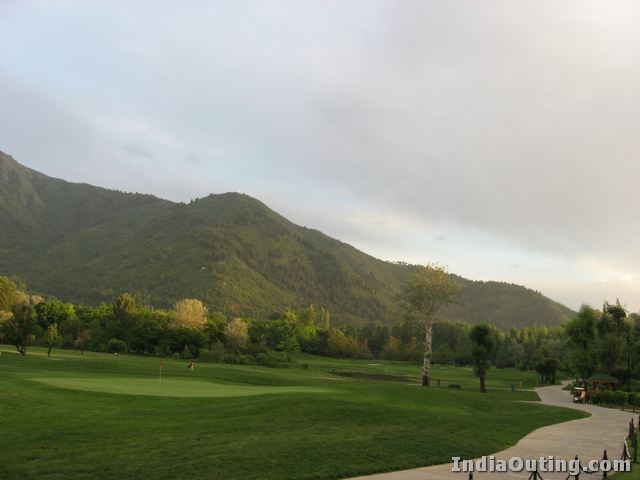
The Royal Springs Golf Course has been carved out of forests within the backdrop of Zabarvan mountains under Chashma- Shahi, the royal springs. The picturesque Chashma- Shahi garden built by the Mughals overlooks the Golf course. A visit to the Royal Springs Golf Course, whether for a day or for over night, is a marvelous experience for both the golf lovers and the nature lovers.
Ever since the golf course was commissioned in 2001, many international level golf tournaments have been held here. Some professional golfers have considered this golf course to be the best in the country.
On entering the golf course you will see an array of club houses and cottages for accommodation followed by the breathtaking beauty of the green. The course is a professional 18 hall, par 72 track which covers an area of 7090 yards approx.
The ideal time to visit the golf course is in the month of May-September when the climate is just about perfect. The complete golf course can be seen by moving about on the green by means of a golf cart.
It is worth being pampered with by the hospitality and the beauty around. With its three lakes, tea shelters, comfort stations, health club, massage parlor, sauna bath, table tennis, pool tables, grapes orchards and peach farm makes the golf course a small luxurious city in itself.


Gulmarg गुलमर्ग
2.jpg3.JPG4.jpg5.jpg6.jpg7.jpg8.jpg9.jpg10.jpg


20110316

Modern Russian military vehicles


Some military equipment rises to the level of celebrity—and in Russia, tanks immediately spring to mind. At a military exposition held over the weekend at Zhukovsky, a town just outside of Moscow, some lesser-known vehicles from the current Russian arsenal were on display. These trucks, missile launchers, communications systems and engineering vehicles are the real backbone of any modern land force. Land battles are a priority here, thanks to Russia's impossibly long land borders. The country now upgrades Soviet designs and sells vehicles internationally for both financial and geopolitical gain. While the electronics and sensors are often a little outdated, it's easy to admire the brute strength and rugged design of Russian military vehicles. Here are some of our favorites from the Engineering Technologies Forum in Zhukovsky, about 25 miles outside of Moscow.
#1. IMR-3M Obstacle-Clearing Vehicle
IMR-3M Obstacle-Clearing Vehicle 
A vehicle built for heavy engineering in tough environments, it's hard not to respect this road-clearing (or -creating) monster. The two-man crew inside the vehicle can breach tree entanglements, blaze an 8-mile trail in an hour and lift 2 tons with a telescoping arm that extends 10 yards. It's also prepared to survive a fight, with thick armor, masking smoke and a machine-gun turret. Best of all, it's mounted on the chassis of a T-90 main battle tank. It can also survive blasts from explosives—the plow can clear pressure and magnetic-fuse mines—making the vehicle an all-purpose brute.
#2. 9A52-4 Multiple Launch Rocket System
9A52-4 Multiple Launch Rocket System 
One hero of Russian history is the Katyusha, a wheeled vehicle from World War II that rained rockets on German troops and tanks. This modern version, a very lightweight rocket launcher mounted on a truck chassis, has a simple design but packs a wallop—the crew inside the cab fires 300-mm rockets with warheads that include incendiary, fuel-air explosive, cluster munitions or antitank mines. The one on display here features six reusable launch tubes, which can be reloaded by a separate vehicle, using a crane, within 8 minutes. While the four-axle truck it's mounted on is not ideal off-road driving, these systems are masters of the shoot-and-scoot; by the time counterbattery fires rain down, they have driven away. This air-transportable version of the popular Smerch rocket system was introduced in 2007 but still awaits an international customer. (The previous, heavier versions are used by India, Algeria, Kuwait and others.)
#3. Kasta 2E Radar
Kasta 2E Radar 
The Kasta is a great all-purpose radar system that can be used to track helicopters, cruise missiles and airplanes. Set this up for remote operation, and you've got a movable defense screen for virtually anything in the air or an air-traffic-control radar that can operate in any weather for up to 20 days. The radar here can cover about 90 miles, depending on the height of the antenna it is mounted on, and can be set up for action in 20 minutes. The Kasta is said to be resistant to enemy jamming. A newer version of this radar is a popular item on the international market and guards Iranian nuclear sites. The diesel engine fires up with a whine, and the old-school mechanical radar dishes spin, unlike newer electronic radar arrays.
#4. 1V13 Artillery Fire Command Vehicle
1V13 Artillery Fire Command Vehicle 
Even the most modern artillery shell or missile is useless without knowing where targets are located. This scrappy recon vehicle is made to operate, day or night, in the most miserable conditions possible to provide guidance to indirect fire coming from large and small formations, from the platoon to the battalion level. The 1V13s are studded with radios, laser rangefinders, navigation equipment and an aiming circle that provides the angle needed to correctly place a round. Once in position, the crew of six can set up to direct volleys of heavy fire within 15 minutes. The low profile and telescoping antenna are meant to protect the crew members as they sneak into position. The guys inside these things need to be close to the enemy to do their jobs—that takes bravery and good hardware, especially since they are favored targets of the enemies. Like almost all Russian military equipment, the vehicle was designed during the Soviet era and has been sold internationally and sporadically upgraded.
#5. 9A39 Launch/Reload Vehicle for the BUK M1-2
9A39 Launch/Reload Vehicle for the BUK M1-2 
The BUK M1-2 Self-Propelled Launch System (called the SA-11 Gadfly by NATO) is tailor-made to spot and destroy aircraft and inbound cruise missiles. In this photo is an oft-forgotten part of the medium-range system—the reloader. The crane, bent in the front, hoists missiles onto nearby Gadflys. The system can't see for itself—it relies on other nearby vehicles carrying radar for targeting—but it can shoot and reload on its own. The missiles are radar guided and can reach Mach 3. These vehicles are sold all over the world, including in Pakistan, Egypt, North Korea, Syria, China and (arriving soon) Venezuela.
#6. MIK-MKS Mobile Communications System
9A39 Launch/Reload Vehicle for the BUK M1-2 
It takes a half-hour for the 100-foot mast of this vehicle to reach its full height. But once it does, the MIK-MKS provides wireless broadband access for 200 users using the four antennas atop the mast. Micran, the company that makes the system in the Siberian city of Tomsk, can tailor it for a variety of other communications uses, but the main purpose of the system is for a single vehicle to connect a slew of dispersed units. It's designed to be hardened against jamming interference from enemies and rough conditions of Mother Nature, especially high winds.
#7. Pneumatic Dummies
Pneumatic Dummies 
Okay, these aren't vehicles, but they've fooled us before. These cheap decoys made by Rusbal, a balloon manufacturer near Moscow, are intended to fool satellites and aircraft by adopting the shape, color, thermal signature (by using heaters) and radar returns of things that would make a juicy target for an airstrike. At the arms show, the company chose to inflate an S-300 antiaircraft missile launcher, the system that Iran is so eager to set up to thwart an Israeli attack on its nuclear facilities, if Russia will ever deliver them. Imagine they do so, with a crate of decoys thrown in. The company catalog includes aircraft, vehicles, hangars, radar arrays and forward operating bases. American military intelligence has been fooled by decoys before—notably by the Serbs, who protected their air force by setting up a fleet of faux targets. Nothing means tactical deception like launching a $600,000 cruise missile against a cheap balloon.